

 Back to all posts
 Junly 22, 2026
 4 min read



Overview
SaySai is a digital health application that allows users to check symptoms such as fever, cough, headache, and other common health indicators, then receive preliminary condition insights and medicine or dosage recommendations based on defined medical logic. Because the platform handles health-related information, it requires accurate recommendation workflows, real-time responsiveness, secure handling of sensitive user data, and scalable infrastructure to support growing digital health adoption.
Key Challenges
SaySai needed to support concurrent symptom queries while maintaining fast response times for users seeking preliminary health guidance. The platform had to process symptom inputs, match them against predefined medical logic, and return recommendations without noticeable delay. Scalability and performance were important because usage could increase during seasonal illness periods, public health events, or broader adoption of digital health services.
The application also required strong privacy and reliability controls because it handles sensitive health-related data, medical history, symptom records, and recommendation outputs. The platform needed secure storage practices, controlled access to operational data, and monitoring for system errors or abnormal behavior. Recommendation accuracy was another key concern, as drug, dosage, and symptom-mapping logic must be updated carefully to avoid outdated or harmful guidance. At the same time, SaySai needed continuous deployment capabilities so updated medical logic and application changes could be released without downtime, while keeping infrastructure costs optimized.
Solution Implemented
B8 ICT Solutions was selected as the AWS consulting partner to design and implement a secure, scalable, and maintainable cloud architecture for SaySai. After reviewing the application's healthcare requirements, performance expectations, and deployment needs, B8 ICT Solutions designed a containerized microservices architecture using Amazon EKS, Kubernetes, GitHub, Amazon ECR, ArgoCD, Cloudflare, Amazon CloudWatch, Amazon S3, and Amazon EC2.
The application services were deployed on Amazon EKS using Kubernetes for orchestration, scaling, and workload management. GitHub was used for source code management and CI workflows, while Amazon ECR stored container images. ArgoCD enabled GitOps-based continuous deployment by synchronizing Kubernetes manifests from Git repositories into the cluster. Cloudflare was used for DNS, traffic protection, and edge-level security controls. Amazon CloudWatch collected application and infrastructure logs, metrics, and alarms, while Amazon S3 was used for storing application artifacts, static assets, audit logs, medical reference files, and backup data. Amazon EC2 supported compute capacity required by the Kubernetes worker nodes and supporting infrastructure components.
Architecture Diagram
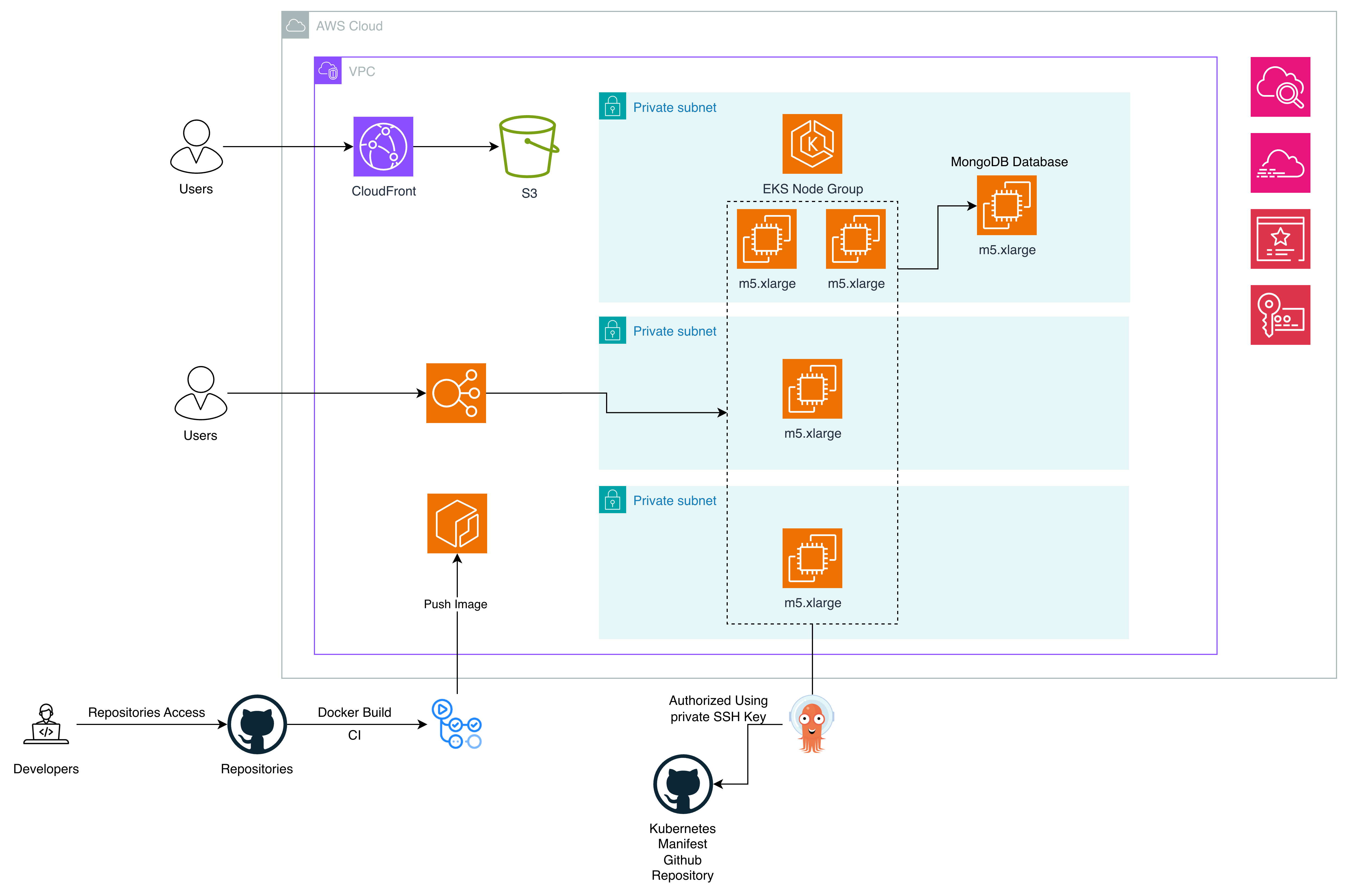
Key technologies implemented in this environment include:
- Amazon EC2: Provides secure and resizable compute capacity in the cloud for running application infrastructure and supporting workloads.
- Amazon EKS: A managed Kubernetes service used to deploy, manage, and scale containerized application services on AWS.
- Amazon ECR: A managed container image registry used to securely store and manage Docker images for deployment to Kubernetes.
- GitHub: A source code management platform used for version control, collaboration, and CI workflow integration.
- Kubernetes: An open-source container orchestration platform used to automate deployment, scaling, networking, and management of containerized services.
- ArgoCD: A GitOps-based continuous deployment tool used to synchronize Kubernetes manifests from Git repositories into the target environment.
- Cloudflare: Provides DNS management, traffic routing, edge protection, and security controls for public application access.
- Amazon CloudWatch: A monitoring and observability service used to collect logs, metrics, alarms, and operational visibility across the platform.
- Amazon S3: A scalable object storage service used to store application artifacts, static assets, audit logs, medical reference files, and backup data.
Benefits
Financial Benefits
SaySai benefits from cost-effective scaling by using containerized workloads on Amazon EKS and Kubernetes. Compute resources can be adjusted based on demand, reducing overprovisioning while maintaining availability. The use of GitOps and managed AWS services also reduces manual operational effort, lowering the cost of deployment, monitoring, and infrastructure management.
Operational Benefits
The GitHub, Amazon ECR, and ArgoCD workflow enables SaySai to deploy updated application services and medical rule sets in a controlled and repeatable manner. Version-controlled deployments improve traceability, simplify rollback, and reduce risk when releasing updated symptom-mapping logic or medicine recommendation rules. Amazon CloudWatch improves operational visibility by tracking service health, application logs, resource usage, and alerts.
The architecture also supports demand spikes during periods such as flu season or increased public health activity. Kubernetes scaling allows application services to expand based on workload requirements, while Cloudflare helps protect public access points and improve traffic handling.
Performance Improvements
The microservices architecture improves system responsiveness by separating application functions such as symptom intake, recommendation processing, user access, and operational logging. Amazon EKS and Kubernetes provide high availability by distributing workloads and scaling services based on demand. Cloudflare improves access reliability at the edge, while Amazon CloudWatch helps the operations team identify latency, errors, and infrastructure issues in near real time.
Strategic and Business Impact
The AWS and GitOps-based architecture gives SaySai a stronger foundation for scaling digital health services while maintaining operational control. By containerizing the platform on Amazon EKS and Kubernetes, SaySai can expand its symptom-checking and recommendation services as user adoption grows, without redesigning the core infrastructure. This supports future product expansion such as additional symptom categories, updated medicine rule sets, AI-assisted recommendation modules, and telemedicine integration.
From a business perspective, the platform improves release agility and reduces operational risk. GitHub, Amazon ECR, and ArgoCD provide a structured deployment workflow that allows new features, medical logic updates, and security improvements to be released in a controlled and traceable manner. Cloudflare, Amazon CloudWatch, and Amazon S3 support secure access, monitoring, and operational recordkeeping, helping SaySai build user trust while maintaining reliable service delivery. This enables the business to scale responsibly in the healthcare sector, where availability, accuracy, privacy, and governance are critical to long-term adoption.
Conclusion
By implementing AWS cloud infrastructure with DevOps and GitOps practices, B8 ICT Solutions helped SaySai establish a scalable, secure, and reliable platform for personalized health guidance. The use of Amazon EKS, Kubernetes, GitHub, Amazon ECR, ArgoCD, Cloudflare, Amazon CloudWatch, Amazon S3, and Amazon EC2 enables controlled deployments, real-time operational monitoring, scalable application performance, and secure handling of health-related platform data. This transformation improves SaySai's technical readiness and business scalability, positioning the platform for future growth through AI-based diagnosis support, expanded medical rule engines, and telemedicine integration.