

 Back to all posts
 July 22, 2026
 6 min read



Industry :
Shopping
Key Technologies :
Amazon EKS, Amazon EC2, GitHub, ArgoCD
Overview
To power a seamless grocery shopping experience, real-time inventory, fast search, and low-friction checkout, the platform needed an operations model that keeps service health visible, risk controlled, and response times tight. B8 ICT Solutions implemented a CloudOps foundation on AWS that anchors availability and performance targets, enforces guardrails by default, and supports continuous improvement without sacrificing delivery speed.
This grocery shopping platform serves more than 300,000 registered users and sees around 2,500 active users each day. Customers expect fast search, fresh inventory, and a smooth checkout that works even during busy salary days and promotions.
The team wanted the AWS platform to stay reliable as the user base grew and as new features were added. They also wanted security, compliance, and cost control to be part of daily operations instead of one time clean up projects. B8 ICT Solutions helped define a way of running the platform that keeps service health visible, risk under control, and changes safe to roll out.
Key Challenges
Traffic patterns were uneven. Promotions, holidays, and payday spikes created short bursts of load that could strain search, inventory updates, or checkout. The platform needed to stretch during those peaks without slowing down and recover cleanly if any part of the flow misbehaved.
Teams did not have one clear picture of service health. Signals were spread across application logs, database views, and infrastructure metrics. That made it hard to see where an issue started and whether a fix had really worked.
In a fast delivery rhythm, small mistakes in configuration could have large impact. The organization needed simple rules that prevented risky changes and continuous checks that spotted drift before customers noticed. At the same time incidents, releases, and patching all needed to follow the same simple pattern during quiet days and during launch weekends so that audits did not turn into manual detective work.
Finally, leaders wanted cloud costs to scale with value. They needed basic expectations up front, clear tagging for accountability, and early alerts when spend started to move away from plan.
Solution
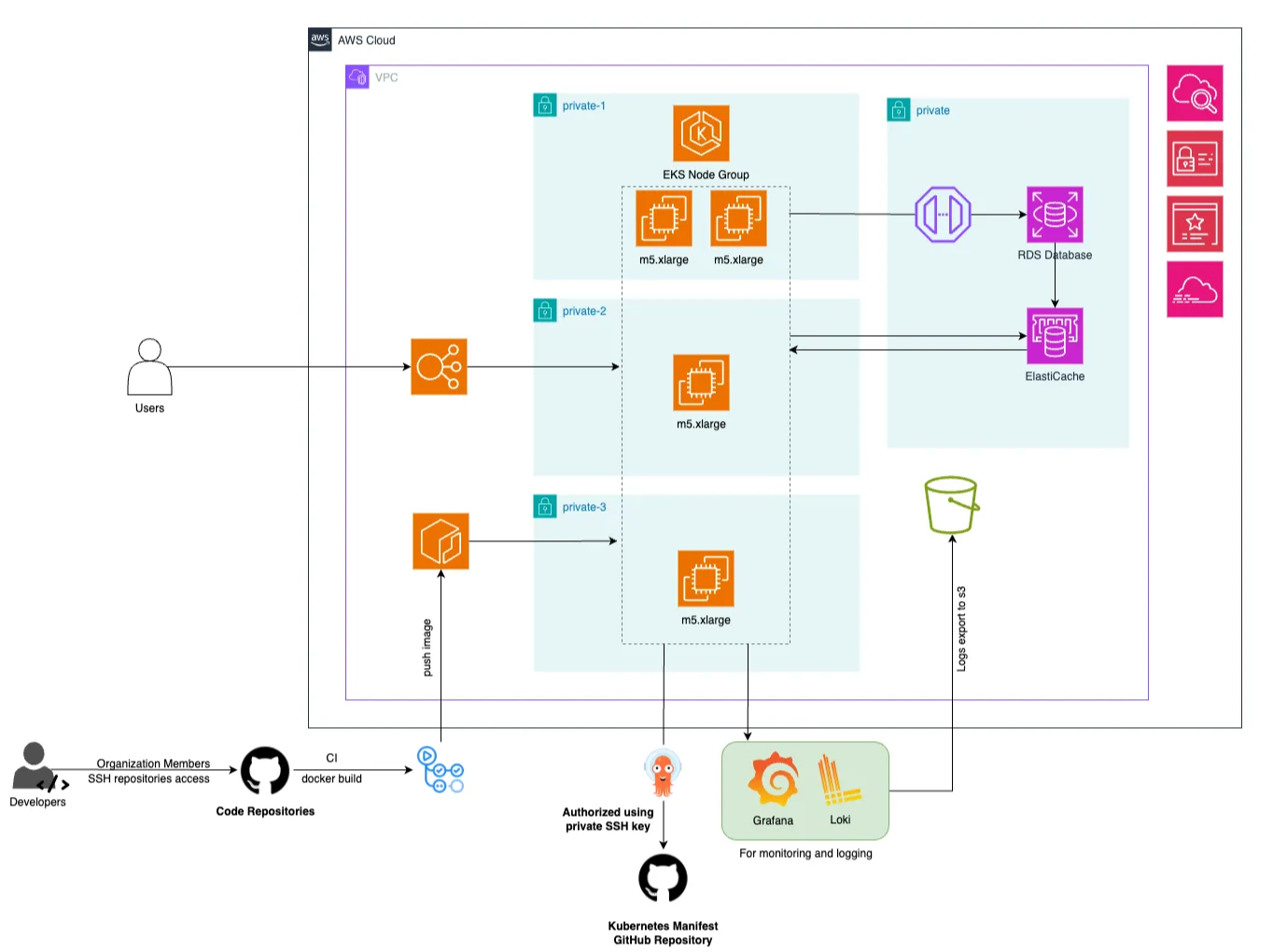
B8 ICT Solutions helped the team build an operating model on AWS around these needs. The application runs on Amazon EKS and Amazon EC2. Data is stored in Amazon RDS with Amazon ElastiCache providing low latency access for frequent reads such as product lists and search results. Amazon Route 53 handles DNS. Images and logs live on Amazon S3. GitHub and Argo CD manage the path from code to cluster so every change has a clear and repeatable journey into production and the same path back out if a rollback is needed.
Service health was the first priority. Application and platform metrics go into Amazon CloudWatch. Logs from services, from the platform, and from the database layer are also sent there. The team uses dashboards to watch the main journeys such as browsing, adding to cart, and paying. They can see availability, latency, and error rates in the same view. Alerts from CloudWatch fire when these signals leave normal ranges and send clear notifications to the on call channel. This means that during a busy evening or a payday campaign, operators can see at a glance which part of the flow is under pressure.
Daily operations use AWS Systems Manager as the main control point for the fleet. Patch Manager applies operating system updates on a regular schedule. Instances and nodes are grouped by environment and role so patch plans are simple to understand. Automation documents and Run Command cover routine tasks such as restarting a service, draining a node, clearing a stuck worker, or applying a small configuration change. During an incident, on call staff follow short runbooks. They open the relevant dashboards, run a small set of checks, use the prepared automation steps, and record what they did. This keeps calls focused and produces a clean trail for later review.
Governance and security are supported by AWS Organizations, AWS Config, AWS Security Hub, and Amazon GuardDuty. Multiple accounts separate production, non production, and shared services. Service control policies in AWS Organizations set simple rules such as which regions can be used and when certain high risk actions must go through central roles. AWS Config records how resources are set up and checks them against rules for public access, required tags, and basic network safety. Findings from Config and GuardDuty feed into AWS Security Hub where the platform and security teams review them on a regular cycle and open remediation tasks or automation jobs. AWS CloudTrail sends a full history of API activity to Amazon S3 so audits and investigations can see who did what and when.
Cost is managed with AWS Budgets and AWS Cost Explorer. Resources follow a tagging standard that marks application, environment, and owner. Budgets watch spend at the account and environment level and send alerts when actual or forecast usage approaches agreed thresholds. Cost Explorer and Cost Categories provide views by tag and by feature. The team reviews these views in regular sessions, looks for idle or over sized resources, and adjusts capacity ahead of known peaks.
Key technologies in this e-commerce application include -
- Amazon EKS & Amazon EC2 : Managed Kubernetes and compute capacity for running and scaling application services.
- Amazon RDS & ElastiCache : Relational data storage paired with low latency caching for product and search reads.
- GitHub & ArgoCD : GitOps-based delivery giving every change a clear, repeatable, and reversible path to production.
- Amazon CloudWatch : Central place for metrics, logs, dashboards, and alarms so the team can see health and get paged when it matters.
Benefits
This approach has given the grocery shopping platform a more stable operating rhythm. Over the first three quarters of 2025 the service kept average uptime around 97.8 percent, compared with roughly 95.9 percent during the period before this model. For priority checkout incidents, average time to resolve dropped from about 40 minutes to around 15 minutes because on call staff use shared dashboards and runbooks instead of starting from scratch each time.
Security and configuration checks now run constantly in the background and produce evidence that can be reused for audits. The number of open high severity findings from AWS Config and AWS Security Hub dropped meaningfully from where it started, giving the team a clear downward trend to point to during reviews. Patching happens on a known schedule through Systems Manager rather than through ad hoc sessions. Changes move through a tracked pipeline with a clear record of what was deployed and when.
From a financial view, leaders have a clearer link between AWS costs and the features and environments that use those resources. Regular reviews helped remove idle or over sized resources and cut waste by about 15 percent while order volume continued to grow. They can see how spend moves when usage grows, adjust budgets, and decide where to invest further or where to tune consumption.
For customers the result is a shopping experience that feels responsive and reliable most of the time. Pages load quickly, search feels snappy, and checkout continues to work through busy periods. That reliability supports repeat usage and gives the product team room to add new flows and partners without constantly worrying about day to day stability.
Financial Benefits
- Cloud spend is easier to explain and plan because resources are tagged and tracked by application and environment.
- Budget alerts and regular cost reviews help avoid surprises and support decisions about where to right size and where to scale ahead of demand.
Operational Benefits
- Shared views of service health and standard runbooks shorten both detection and recovery during incidents.
- Guardrails and continuous checks reduce the number of risky changes that reach production and cut down manual clean up work.
- Git based delivery with Argo CD keeps releases fast but controlled and makes rollback simple when needed.
Performance Improvements
- Clear objectives for latency and error rates keep teams focused on the customer experience and not just on infrastructure statistics.
- Autoscaling and caching allow the platform to absorb traffic spikes with less impact on checkout and search.
- Combined signals from the application, the platform, and the underlying infrastructure reduce guesswork and speed up root cause analysis.
The collaboration between B8 ICT Solutions and the grocery shopping mall app drives continuous innovation, enhances agility in a growing digital marketplace, and strengthens the platform's ability to provide a secure, seamless, and reliable shopping experience for customers and merchants.
Conclusion
By adopting a CloudOps-first approach, clear SLOs, shared dashboards, policy-by-default guardrails, automated corrections, and disciplined runbooks, the grocery shopping platform now delivers a dependable, fast checkout experience through traffic surges, recovers quickly when issues appear, and produces clean evidence for audits and cost reviews. The operating rhythm supports rapid, controlled change and positions the team to scale features and markets without losing stability.