 Back to all postsCase Study
Modernizing Myanmar’s Payment Gateway with AWS and CloudOps Practices
 November 17, 2025
 7 min read




Overview
Dinger is a leading payment gateway in Myanmar. It connects around 6000 merchants to banks and wallets and handles about 15,000 online payment transactions every day. Any slowdown or outage can affect revenue and trust for both merchants and end users.
The company wanted its core platform on AWS to stay reliable as traffic grows and as new products are added. Security and compliance needed to fit into daily work, not stand apart as one time projects. Together with B8 ICT Solutions, Dinger moved toward a cloud operations model that puts service health, security, and clear ownership at the center of how the platform runs.
Key Challenges
The team faced a few practical problems as the business grew
They needed a clear view of payment journeys end to end. Engineers and operators had to see in one place whether issues came from the application, the platform, or an upstream integration. Spikes during promotions and seasonal peaks had to be handled without guesswork. The platform needed to scale in a controlled way so that latency stayed low and checkout remained smooth.
Security and compliance work was becoming heavier. The company wanted checks to run all the time with clear evidence for reviews, rather than last minute exercises before an audit.
Releases were frequent. The team needed a simple and reliable way to ship changes and roll back when something did not behave as expected. At the same time leaders wanted better insight into how cloud spend tracked against products and environments.
Solution
B8 ICT Solutions designed a CloudOps architecture focused on observability and governance:
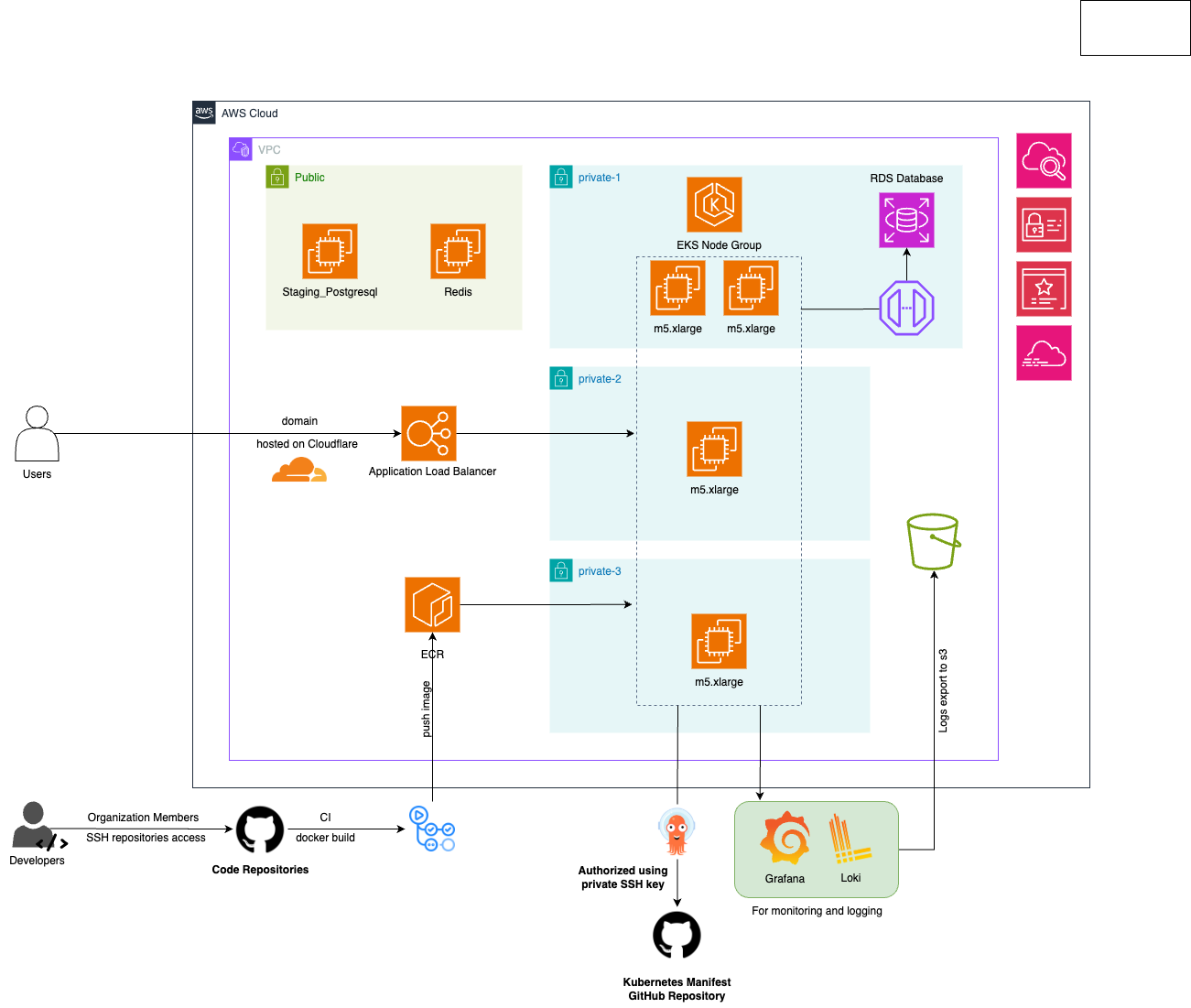
B8 ICT Solutions helped Dinger shape an operating model on AWS around these needs. The application runs on Kubernetes with Amazon EKS and Amazon EC2 as the main compute layers. Payments and account data use Amazon RDS Aurora. Amazon S3 holds logs and other durable data. Cloudflare sits at the edge, protects public endpoints, and absorbs some of the internet noise before it reaches the cluster. GitHub Actions and Argo CD handle delivery into Kubernetes so every change has a clear and repeatable path from source code to production.
Visibility into service health was an early focus. Application and platform metrics go into Amazon CloudWatch and Prometheus. Grafana brings those signals together on dashboards that show the key payment flows. Teams can see success rates, latency, and error patterns in a shared view. CloudWatch alarms and Prometheus alert rules watch those metrics and send notifications to the on call channel when thresholds are crossed. Logs from the gateway, from the platform, and from the database layer are stored on AWS so investigations and trend analysis are easier.
Day to day operations use AWS Systems Manager as the main control surface for the fleet. Patch Manager applies operating system updates on a regular schedule with instances grouped by role and environment. Automation documents and Run Command cover common tasks such as restarting a service, draining a node, or applying a simple configuration fix. When an incident happens, on call staff follow short runbooks. They open the relevant dashboards, run a small set of checks, use prepared automation steps, and record what they did. GitHub Actions and Argo CD provide an audit trail for deployments so it is straightforward to identify which release introduced an issue and to roll back if needed.
Security and compliance are backed by AWS CloudTrail, AWS Config, AWS Security Hub, and Amazon GuardDuty. CloudTrail records API activity across accounts and regions and sends it to Amazon S3 for long term storage. Config tracks how resources are set up and checks them against rules. These rules cover topics such as public exposure on storage, network openings, and required tags. Findings from Config and GuardDuty flow into Security Hub where the security and platform teams review them on a regular cycle and create remediation tasks or automation where it makes sense. This gives Dinger an up to date view of its security posture without extra manual work.
Costs are managed as part of regular operations. Resources follow a tagging scheme that marks application, environment, and owner. Dinger and B8 ICT Solutions review AWS billing data and simple reports to see how much each part of the platform spends and how that changes as traffic grows. This review feeds decisions about right sizing instances, adjusting capacity for peak events, and planning future changes to the architecture.
Key Technologies is this payment gateway service include -
- Amazon CloudWatch : Metrics, logs, dashboards, and alarms to monitor service health and enforce SLOs.
- AWS CloudTrail : Immutable audit trail of API activity across regions for change tracking and investigations.
- AWS Config : Continuous configuration assessment and drift detection against defined rules and policies.
- AWS Systems Manager (SSM) : Patch Manager, Automation, Run Command, and Parameter Store for fleet ops and runbooks.
- AWS Security Hub : Centralized security posture management against CIS and AWS best practices.
- Amazon GuardDuty : Continuous threat detection from account, network, and workload telemetry.
- Amazon Inspector : Automated vulnerability findings for EC2 and container images.
- AWS Backup : Centralized, policy-based backups and restores for compliant data protection.
- Amazon EventBridge : Event routing to trigger notifications, workflows, and automated remediations.
- AWS Lambda : Serverless handlers for alert notifications and auto-remediation actions.
- AWS Budgets : Cost thresholds and alerts to control monthly run-rate and variances.
- AWS Cost Explorer & Cost Categories : Cost thresholds and alerts to control monthly run-rate and variances.
- AWS IAM Access Analyzer : Analysis of resource-sharing policies to reduce unintended access.
- AWS Organizations & SCPs : Multi-account governance and preventive guardrails at the org level.
Benefits
This operating model has made the payment gateway more predictable to run. Priority payment incidents that used to take about 30 minutes to resolve now usually take around 5-10 minutes. Teams see the same picture of service health and can act quickly when something looks wrong, so fewer incidents grow into larger outages.
Security and compliance checks now run in the background and produce evidence that can be reused for reviews and audits. The number of open high severity security and configuration findings from AWS Config and AWS Security Hub went down from about 56 at the start of the work to less than 15 on average. Changes move through a tracked pipeline so there is less risk when new features go live. The platform can handle growth in payment volume with less stress on the operations team and has kept API availability around 98.9 percent during peak campaigns.
From a financial point of view, leaders have a clearer view of how AWS costs relate to products and environments. They can explain monthly spend, adjust budgets, and weigh new features against their expected usage and cost.
Most importantly, merchants and end users see a payment platform that feels stable and responsive even when demand is high. That stability supports trust in the brand and gives Dinger room to keep adding new payment options and services.
Financial Benefits
- The platform reduces revenue loss from outages and reduces support effort by catching issues earlier, with fewer customer reported incidents per month compared with the period before this model.
- Clear cost ownership and budgeting help avoid overruns and support sustainable growth as transaction volume increases.
Operational Benefits
- Standardized runbooks clear ownership and preventive guardrails streamline daily work and shorten incident calls.
- Continuous evaluation and automated responses reduce manual toil and keep the environment closer to its intended state.
Performance Improvements
- Service health objectives for availability and responsiveness guide decisions and focus improvements in the busiest payment flows.
- Consistent release practices and scalable architecture maintain performance during peak demand.
The partnership between B8 ICT Solutions and the payment gateway service fosters continuous innovation, enhances agility in a growing digital market, and reinforces the platform ability to provide secure seamless and reliable transactions for merchants and users.
Conclusion
By running its payment gateway on AWS with a cloud operations mindset, Dinger and B8 ICT Solutions built a platform that is easier to observe, safer to change, and simpler to govern. The work around visibility, automation, security, and cost control means the company can focus on new features and partnerships while keeping day to day operations under control.